|
This page was exported from Bancroft this Week
[ https://www.bancroftthisweek.com ] Export date: Thu Oct 22 3:16:46 2026 / +0000 GMT |
Touching the Great Again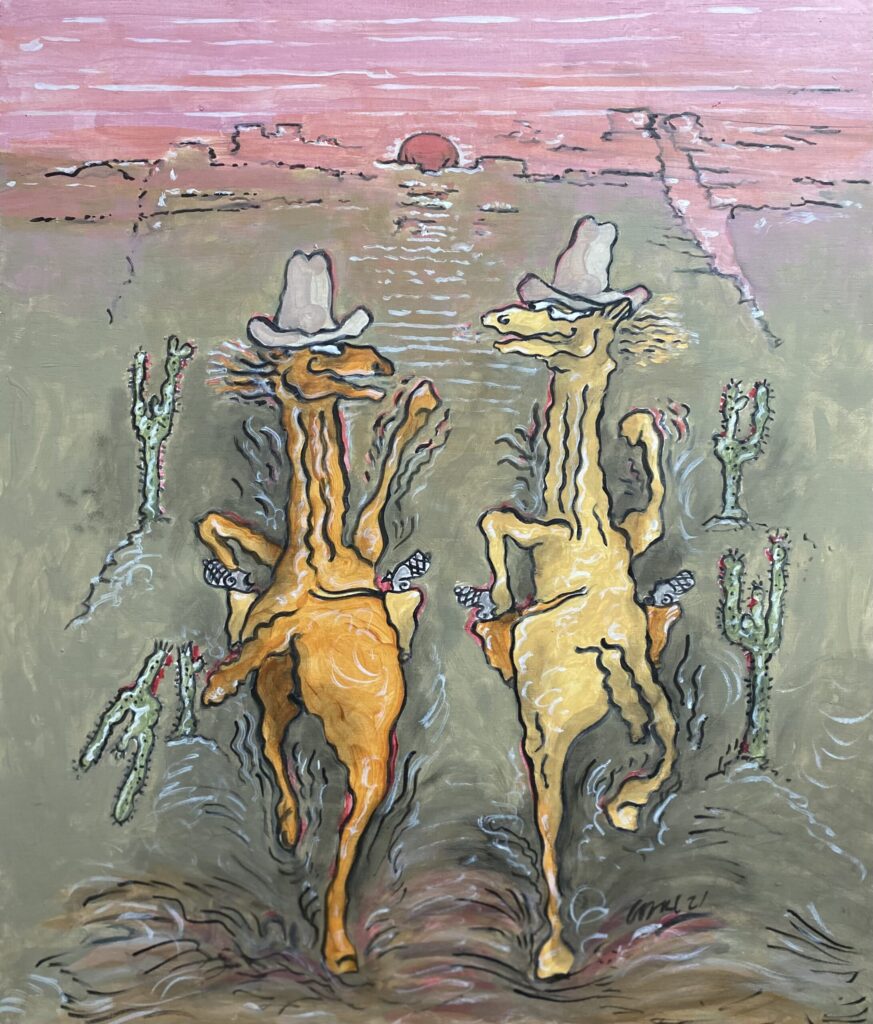 By Nate Smelle 'Twas just before 5 a.m. on the morning of Jan. 15 when I awoke with a strange feeling that something big was happening. Looking out my bedroom window, noticing nothing out of the ordinary I resisted the temptation to check the news on my phone and sank back into my pillow and continued dreaming. Waking up again a few hours later, I picked up my phone to find a message informing me that my good friend Arne Roosman had passed away while I was asleep. It is now almost 11 p.m. on Sunday, Jan. 18 and I have been struggling to find the right combination of words to honour the man who I have come to know and love. Over the past six years, Arne and I have spent hundreds of hours together, digging deep into his rich personal history and even deeper into his observations of the dysfunctional world we live in today, as we put together his memoir, 'Twas a Sunny Day. I first met Arne on the Day of the Dead in 2014 during an exhibition of his work at the Art Gallery of Bancroft entitled Here & Now/There & Then. Hitting it off right away we made plans to get together the following week at his place beside the York River, for a private tour of his studio and viewing of some of his works in progress. Greeted by his big, fluffy, white friend Uku upon my arrival, I heard Arne's voice calling me from inside to join him for a drink on the riverside deck. Pouring us each a couple of fingers of the finest Canadian whisky from his cabinet, we admired the setting sun for a short time and then went inside to have a look at what he'd been working on. Astonished by the sheer number of paintings and drawings adorning the walls on both levels of his home studio, my jaw dropped to the floor when I noticed that every room also had tables full of artwork. Focusing in on as many of his pieces as I could on this studio tour, it was obvious that Arne was much more than just a prolific and talented artist. Of course anyone can find meaning in any piece of art, however with Arne's work I could see a depth unlike anything I had experienced. Not only did every one of his pieces tell a story, they each inspired a neverending chain of questions: “What's the deal with the guy on horseback swinging the sabre?” I remember asking. “Who are these ghostly faces in striped pajamas peering through your window?” As compelling as our first real encounter was, it wasn't the moment that our journey through the past and into his heart and mind began. That moment came on the winter solstice of 2019. Our interview on that day—as with most of our engagements over the years—turned out to be a visit that lasted almost four and a half hours, six beers, and half a bottle of Irish cream whisky. Chewing the fat, we discovered our shared love of music, especially jazz and classical, Ella Fitzgerald, Nat King Cole, Natalie Cole, Oscar Peterson, Beethoven, and Schubert. We spoke of the healing power of art; the disappearing art of philosophy; our reverence for beauty; the absurdity of U.S. president Donald Trump's infantile behaviour, and the innate ugliness of his neo-fascist “MAGA” movement. The following are excerpts from our conversation that day, as featured in Arne's memoir: Walking through his home that morning it felt as if I was entering a ceremonial space. On the kitchen table there were several candles, carefully placed around a wood carving of an evergreen tree that he had decorated with white lights, red bows, and silver tinsel. On the radio, there was classical Christmas music playing loudly. I sat down at the table, soaking in the unique ambience of the room as he made his way up the ramp to join me. “It looks like you've been a busy man,” I said, motioning to the traces of creativity throughout the room. “Are you working on something new?” “This is what I've been up to,” Arne said with a smile, as he pushed a big red binder across the table. Loosely organized into the book were a stack of roughly two dozen sketches along with several notes, loosely attached to the drawings with green masking tape and staples. On the cover of the binder in gold ink were the words, Touching the Great Again: Visiting a Nursery. I carefully flipped through the pages in an effort not to disturb their order. With each turn I followed his orange-haired, dirty-diaper-waving wannabe dictator on the road to ruin. Stapled to one of Arne's drawings of the infantile ruler, fast asleep on a bed of coins and cash — was a quote: How does tyranny arise? That it comes out of democracy is fairly clear. Does the change take place in the same sort of way as the change from oligarchy to democracy? Oligarchy was established by men with a certain aim in life: the good they sought was wealth, and it was the insatiable appetite for money-making to the neglect of everything else that proved its undoing. Is democracy likewise ruined by greed for what it conceives to be the supreme good? — Plato's The Republic As was its intention, the quote that Arne had chosen caused me to question: From where does tyranny arise? Can a democracy function as long as greed remains unchecked? Do most people need a leader to tell them what to do and who to hate? Was Nietzsche right? Do we earn our freedom by taking control of ourselves? These were all questions that had been on my mind regularly since The Donald seized the White House in 2016. “People like these so-called ‘strong men', as they are called … ‘strong men',” Arne said, raising his fist. “I've heard Trump referred to as one of these ‘strong men'; and how it is part of his ‘appeal' as the media says. When I hear that I wonder what they mean by strength, and what it means to be a ‘strong man'. Does being a ‘strong man' just mean being a greedy, racist asshole and a bully? If you ask Dr. Freud or Dr. Jung, the ‘strong man' is probably a weak man trying to hide his weakness.” “In other words, it's all about him,” I said.“As soon as anyone disagrees with him – even if they are his biggest supporter – they're done, and they're not a part of his club anymore. So many people could see it coming, but somehow, we couldn't stop it... It's disturbing that people admire his illusion of strength so much more than they do people who are genuinely strong.” “A lot of our neighbours never take it that far,” Arne responded. “Most people that vote, vote by habit since they are expected to vote. Democracy depends on those that expect to be engaged. Without them we get nowhere. That keeps a lot of people on the sidelines away from action though, because they say, ‘Well, it doesn't matter what I say, nobody will listen'. I think that's where we are at now. Even when we elect a good leader, or at least not a horrible leader, they don't really get your attention as much because things are OK. But then, when we get a terrible leader, say a tyrant like Trump, they may be awful, absolutely disgusting in every way, yet there will always be more than enough people who like that terribleness.” “They're passionate about Trump because he gives them permission to hate,” I said. “Whether they hate different races, genders – any group of people different than they are really – Trump is there to empower them to hate themselves.” “That's right!” said Arne. “He says exactly what they want to hear to rile them up.” “Are they that bored? I queried. “But I guess when things are good, people don't make as much noise. We're not out in the streets with signs saying, ‘Thanks for the roads, schools, and hospitals!' I think most of us here take that stuff for granted, so it's not as exciting as it is for them when Trump says, ‘We have to kick the Mexicans and the Muslims out!' He gives us an enemy.” “Crazy, crazy world!” said Arne. “What are we going to do about it, Nate?” This was the same question Arne asked me the last time I spoke with him. During the call we talked about the Epstein files and The Donald's campaign to protect pedophiles, the latest mass murder on the high seas off the coast of Venezuela, and the war criminals conference in Mar-a-Lago. “What are we going to do about it, Nate?” Arne asked again. As we were weaving together what has turned out to be Arne's Swan song, I asked him what he would do if he had another 100 years on this planet. “I would really work like Picasso,” Arne replied. “I would do what I think should be done intellectually to open the eyes of the millions who don't know how to look at life... We are together in this, and together we have kept on killing, killing, killing! It is together, now, our time to stay alive, and enjoy; to be, be, be!” Watching the news today, and yesterday, and the day before that, it appears we cannot stop ourselves from killing. On the upside, the power to change our behaviour is in our hands, and our hands alone. So, I will leave you with the same question Arne asked me: “What are we going to do about it?” Rest in Peace, my friend. |
|
Post date: 2026-01-23 08:13:35 Post date GMT: 2026-01-23 13:13:35 Post modified date: 2026-01-23 08:13:38 Post modified date GMT: 2026-01-23 13:13:38 |
| Powered by [ Universal Post Manager ] plugin. HTML saving format developed by gVectors Team www.gVectors.com |