
Headline News
Daughter reflects on father, Arne Roosman’s legacy of kindness and creativity
January 30, 2026
By Nate Smelle
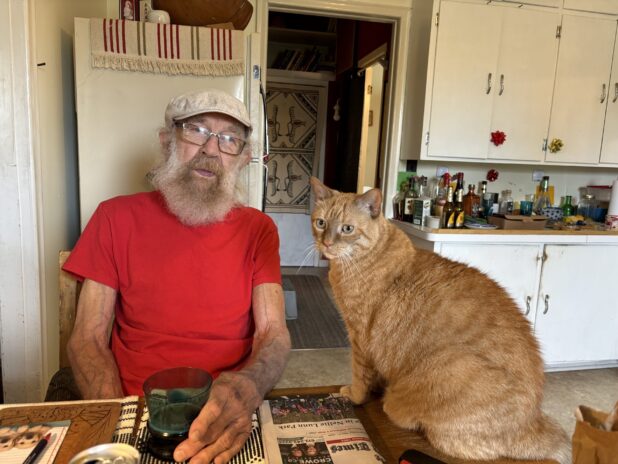
At 5:10 a.m. on Jan. 15, the world grew less colourful with the passing of beloved artist, storyteller, mentor, and community icon, Arne Roosman, who passed away at the age of 93. For those who knew him personally, and for the many who knew him through his art, his absence feels profound. At the same time, his presence—still shining on through the canvases, poems, murals, memories, and conversations he leaves behind—remain vividly alive.
Born on March 6, 1932, in Tallinn, Estonia, Arne’s life began amid a period of upheaval. As a child, he survived the devastation of the Second World War, fleeing the Soviet invasion of Estonia with his family, only to spend the remainder of his youth under the oppressive Nazi regime. These early encounters with tyranny, fear, and loss shaped his worldview, along with the moral and emotional depth that would later infuse his creative work. From an early age, Arne understood both the fragility of life and the resilience of the human spirit.
After the war, he studied art in Sweden, refining his technical abilities while nurturing a rich inner world shaped by myth, dream, history, and nature. In 1957, he emigrated to Canada, where his artistic voice truly flourished. Over more than seven decades, Arne built a remarkable career as a painter, poet, lithographer, muralist, and illustrator—an artist who defied easy categorization and resisted confinement to a single medium or style. His work was imaginative and deeply human, rooted in lived experience and a lifelong engagement with beauty, suffering, and wonder.
But Arne Roosman was far more than the sum of his artistic achievements. He was a father, husband, friend, and mentor whose influence radiated outward through quiet acts of kindness, curiosity, and empathy. Nowhere is this more evident than in the reflections of his daughter, Rebecca Mackay-Roosman, whose memories paint a portrait of a man deeply attuned to the world and to the people he loved.
Rebecca was en route from Dublin to be with her father in his final hours when she received the call from the hospital in Bancroft. Standing in the middle of a bustling airport terminal, she collapsed into grief. “I just fell to pieces,” she aid. “It was so terrible. Nobody should have to go through that. I was on the way to come and hold his hand and be with him in the hospital.”
In that moment of devastation, as she was crying on the phone with her husband Neil, compassion appeared unexpectedly: a woman approached, offering a cup of tea and water, a small human kindness that mirrored the generosity Arne himself practiced throughout his life. Even in death, Rebecca said she felt her father’s presence guiding her—moments falling into place as if gently arranged by his hand.
On the plane, she raised a glass of champagne to him, listening to Irish folk music he loved. The first song to play was, “The Parting Glass” by The Wailin’ Jennys. It felt, to her, like a final gift. “It’s as if he’s like, ‘This is what I’m doing for you,’” she said. “It just fell into place as if he was following me around, saying, ‘This is where you’re going.’ I’m thinking, Dad, you must have been there. I feel him at my back constantly, and I still do. I can feel his soul.”
Arne and his wife, Liina fostered a home filled with art, music, books, and stories. Summers and winters alike were spent with their daughters Rebcca and Anne, immersed in nature—camping near Palmer Rapids, skiing at Stevenson Lodge, holidays defined by shared meals cooked on a wood stove, Estonian traditions, and laughter. Arne believed deeply in engaging with the natural world, encouraging his children to be outside, to observe, to feel part of something larger.
“He really loved going out into nature and being out in nature,” said Rebecca. “It was always so magical. We took our cross country skis, one year when we went out there. Dad bought skis for the entire family, for Christmas. That was the first year up at Stevenson’s. He said, ‘We’re going up to Stevenson’s for Christmas, and we’re gonna do some skiing.’ He was so encouraging with being out in nature. When we went in the summers, it was always all about being outside; not sitting around inside the cottage. Mosquitoes, no mosquitoes, it didn’t matter. He’d say ‘Get out there and just enjoy the whole experience of engaging in the natural world.’”
Arne’s words of wisdom always had a way of sinking in deeply. Recalling a moment with Arne from her childhood, she described an encounter with an Earth worm on a rainy morning that taught her the value of empathy for even the smallest living thing.
“It was a rainy morning, and Dad was getting ready to go to work. I was looking at worms, and I think he thought I was going to step on one, because I was pushing it with my foot, touching them. He came up to me and he said, ‘Don’t do that.’ I said, ‘Don’t do what?’ And he said, ‘Don’t step on anything like this.’ He was concerned. He thought, because he saw my foot doing stuff, I was going to step on it. He said, ‘How would you feel if you were that little worm, and you just saw this massive big foot just coming up to squish you? And I said, ‘I wasn’t going to squish it, I was just pushing it.’ He said, ‘For you, it’s a little foot, but for it, it’s like a giant.’ He was so worried I was going to kill this little worm just by pushing it around with my foot.”
Throughout his life, that same empathy defined Arne’s personal philosophy, his politics, his art, and his relationships.
Arne’s artistic output and encouragement of creativity was boundless. Rebecca said he always encouraged his children draw, write, imagine—never dismissing, always affirming. When Rebecca, at age three, drew a cat upside down because it was “walking on the ceiling,” she said Arne framed the picture, celebrating her creative talents.
In 1988, Arne and Liina left Toronto for rural Hastings County, choosing health, peace, and creative freedom over the pressures of the city. It was a turning point that allowed Arne’s connection to the land and community to deepen further. Reflecting on what led the Roosman family to move to the Bancroft area, Rebecca said: “He was in the car, home from work one summer, and he was just sitting in his car. Just sitting there, staring up, with his hands on the wheel. He told me that it was so bad, his heart was pounding so hard, and his head was pounding so much from the stress. He said he made the decision that it was enough, because he could see how it was affecting his health … I think he thought he was having a heart attack. So he was trying to calm himself down at the wheel before he came in the house.”
As Rebecca grew older, their relationship deepened into long, searching conversations—often stretching late into the night—focused on philosophy, art, social justice, and the state of the world.
“I remember one time when we when I came to Canada after being on an plane for 13 hours, coming over from Riyadh to Toronto,” she said. “Dad and Mum picked me up from the airport. We were sitting around, having dinner, drinking wine, and then Dad and I just kept on talking, and talking about all sorts of things … from writers to philosophies to politics. We were living in this kind of a world now with Gulf War Ships and all that stuff. And maybe I was becoming a little bit more aware, more self-aware, more aware of my surroundings, because as a child, I kind of coasted a little. We just kept on talking, drinking beer, talking, drinking, talking. Suddenly I looked out the window and it was light outside. It was 7 a.m. in the morning. I said, ‘Oh my God, Dad, it’s 7 o’clock in the morning!’ He said, ‘Oh my God, really?’ I said, ‘I think maybe we should get a couple of hours to sleep at least.’ … I suppose that’s the first time we really had a massive heart to heart. That was quite significant, because that memory has stayed with me. That was kind of the one that started all of these late night talks, and they’ve just been going on ever since.”
Arne’s opposition to tyranny, shaped by his early life, resonated powerfully with his daughter’s own political awakening, particularly through her work with women in Saudi Arabia. Although at first he objected to his daughter living and working in a country where public executions and human rights violations were part of the status quo, she said he eventually acknowledged how proud he was of the work she was doing. When she shared stories of her students—of creativity constrained yet fiercely alive—Arne listened with compassion, challenged and moved, his empathy extending far beyond borders.
“We would still talk about it … the Saudi thing,” said Rebecca. “I really wanted to talk to him about this because it was so important for where both of us are politically and how we both agree so much with each other. And he actually said, you know, ‘I’m really quite amazed at what you were doing out there.’ He started asking me questions about what it was it like for the women I taught … I said, ‘Well, here’s an example, Dad.’ I had a student. I won’t mention her name, but I’ll call her May. May was a quiet, shy, very reserved person, but she was a very good painter. She was mostly self taught, and we were talking about women, and she was one of them who was really affected emotionally, by a lot of the restrictions that they had there. ‘Most women just accepted it,’ she said. She asked me, ‘Can I bring you some of my art, to show you privately?’ I said, ‘Sure, come on a day when there’s no classes, and I’ll make sure that I’m the only one in the office, so nobody knows what you’re showing me, because it could be dangerous. So she brought in her portfolio and there was one oil painting she had done—she said, it was a self portrait—and it was of her behind bars, weeping. And she said, ‘This is what life is like for us here.’ I told my father that story and he was really moved by it. I was telling him of my experiences there, and of the women that I was working for, and how strong they are. At the same time, they’re so very kind. I have never met a sisterhood like that ever. And it used to make me wonder about what’s wrong with us in the West here. We’re so divided.”
In Bancroft and beyond, Arne became a local legend—not through self-promotion, but through presence. His art, his conversations, his attentiveness to peace left lasting impressions on all who encountered him. Local artist Dave Maris said he met Arnie when he was doing characters portraits raising money for the Art Gallery of Bancroft. Providing into how influential Roosman was in the arts community throughout the region, Maris said:
“Arne is an individual that gave of himself and his talents to other artists. By their very nature most artists have self-centred individual traits to a fault. Arne was the opposite of that. With his personality he was able to understand and reach artists where they were at currently … and enhance them and their confidence in order to boost them to the next level (s). We] spent many fuelled nights in heated discussions — those always political — allowed me to make the leap to neo-political expressionism throwing my activism into my work. I ‘listened’ to him more than once.”
Arne lived a life shaped by survival, imagination, and profound care for the world around him. He taught, by example, that beauty matters, that empathy is a moral act, and that art is not separate from life but woven through it. Reflecting further on her father’s legacy, Rebecca said: “He led me into loads of the magical places in the world, through poetry, through art. He’s been a real mentor and an encourager in my life. One thing I think that really connected us was when I was in my teens. I asked if I could take riding lessons. He’d never been into horses before this … He was the one who took me out to riding lessons every Sunday in Maple, Ontario; and he used to sit and watch all the horses and the people riding the horses. If he wasn’t watching us doing our stuff in the arena, he’d go out onto the where they were being pastured, and stand with them, and talk to them, and pet them, and draw them. Our love of horses was one thing that really connected us.”
“I’m talking about these stories because these are all extensions of who my father was,” she added.
Though he is gone, Arne Roosman’s creative spirit lives on with those he loved, in the forests and rivers he cherished, and the art he created. His life was an ever-evolving conversation with the world, one marked by listening and learning as much as by expression; a conversation that will not end.




Headline News
Faraday endorses proposed Alto high speed rail station in Madoc
By Bill Kilpatrick, reporter At their Feb. 4 council meeting, Faraday Township council endorsed the forthcoming Alto high speed rail corridor coming soon which will ...
Wollaston preliminary budget proposes 6.97 tax increase
By Bill Kilpatrick, reporter At the Feb. 10 meeting of Wollaston Council, the Treasurer Matt Walker presented the first draft of the 2026 Wollaston Township ...
Carlow Mayo holds Snowman Building Contest
By Michael Riley, Local Journalism Initiative Reporter The Carlow Recreation Committee launched a Snowman Building Contest on Feb. 7 that will run until Feb. 28. ...
Faraday agrees to TTCI request
By Michael Riley, Local Journalism Initiative Reporter At their meeting on Feb. 4, Faraday Township council heard from Kelly Wallace, executive director with the Think ...
Bancroft Boxing expanding programs for all ages
By Bill Kilpatrick When professional mixed martial arts fighter Cody Purtell opened Bancroft Boxing and Grappling in April of last year, he experienced a steep ...
Council votes to allow aerial spraying of herbicide in South Algonquin
By Nate Smelle South Algonquin Township council has reversed its earlier stance on aerial herbicide spraying, voting on Jan. 14 to allow the forestry industry ...
Bancroft awarded over $2 million for water infrastructure project
By Bill Kilpatrick On Jan. 28 MPP for Hastings—Lennox and Addington Ric Bresee announced that the Town of Bancroft was receiving $2,226,500 in provincial funding ...
Daughter reflects on father, Arne Roosman’s legacy of kindness and creativity
By Nate Smelle At 5:10 a.m. on Jan. 15, the world grew less colourful with the passing of beloved artist, storyteller, mentor, and community icon, ...
Home Again fundraisers help animals in need
By Nate Smelle Since it’s inception in 2009, Home Again Animal Rescue has relied on the generosity of the community generosity, and the determination of ...

Municipalities don’t expect to run short of salt
By Bill Kilpatrick The last major road salt shortage occurred in 2018/19 and was the result of a strike by 350 Unifor Local 16-O members ...


