
Commentary
The resistance of Arne Roosman
January 25, 2026
By Chris Houston
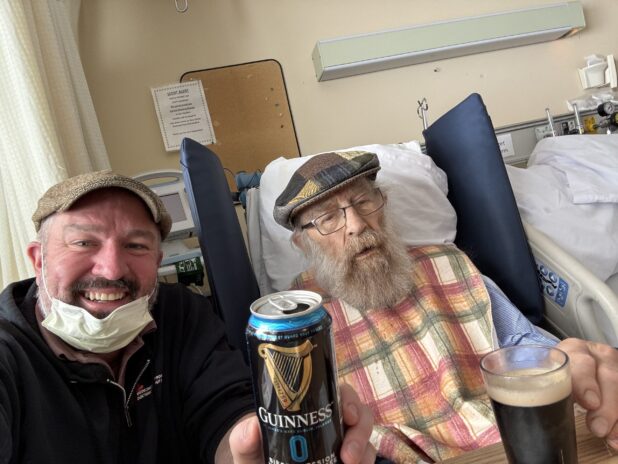
I spent Sunday afternoon at North Hastings Hospital visiting Bancroft’s most famous artist, Mr Arne Roosman. As we shared an alcohol-free Guinness, Arne reminisced about stories from his younger years. Aged 93, Arne has lived in Estonia, Germany, Sweden and Canada.
Arne was born on March 6, 1932 in Tallinn, Estonia. Eight years later, Soviet forces moved in, occupying the nation in the midst of the Second World War. Arne’s family fled Soviet forces, only to find themselves living under the oppression of the murderous Nazi regime.
I first met Arne in the summer of 2025 at his home in Coe Hill. Arne hosted a group of us at his house, sharing pizza and beer as others filmed an interview for an upcoming book launch. Published by Studio Dreamshare Press, Twas a Sunny Day was launched in late 2025. Written by Nate Smelle and packed with Arne’s art and historical newspaper clippings, the book focuses on stories from Arne’s life and his reflections on politics in the 20th and 21st centuries.
Arne is disdainful of the men who orchestrate violence, oppression and authoritarianism. His stories of courage go back to 1940, when Arne and his two brothers took action to resist the Soviet forces that had invaded their home town.
Shortly after the tanks rolled into town, Arne, Gösta, and Benny embarked on plot of patriot subterfuge. Nate Smelle retells Arne’s account: “Spying a cache of oil drums stashed at the forest’s edge atop of a steep hill, and a row of unguarded Russian T34 tanks parked at the bottom of said hill, he said they prepared themselves to unleash a barrel full of sabotage.”
The book switches to Arne’s commentary: “There was this group of happy red conscripts, sipping their seemingly inexhaustible supply of vodka. They did not give much of a damn what took place around them. The T34 Tanks were parked by the dozens behind the cloister. Oddly, the oil which kept the army moving, when necessary was stored in sizeable drums up on the hill. With considerable effort, we managed to open the lock ups, and down the hill, we rolled the juice from Baku. Squirting up in the air, down in the grass, messing up the hillside, and smashing into the war machines with a bang!” Resistance is a theme in Twas a Sunny Day. Stories include Arne’s father Axel smuggling food to the Italian resistance movement.
During my visit to Arne in hospital, there was a lot more singing than I expected. Arne is a big believer in the power of music. His family used some of the songs to protect their lives. As refugees, the Roosman family made a perilous journey from Estonia to Germany, navigating deadly threats from both Soviet and Nazi troops. At each encounter, they had to pretend to be loyal to whichever force they encountered – learning German and Russian songs helped their cover story. Eight decades later, in the hospital ward, a surprised nurse appeared with a smile as Arne sang in two languages. The compassion and care of the medical team in the inpatient ward was palpable and heart-warming.
As I drove home from visiting Arne, the radio broadcast stories of resistance to authorities. Reports from Iran indicate that over 500 people have been killed in anti-government protests. The killing of Renée Good by U.S. immigration authorities provoked over 1,000 protests across the United States.
We are living in unpredictable times. It’s difficult to know what to expect. In the Foreword to the book, publisher Cameron Montgomery asks “Are we doomed to repeat the past? Or can the good people of earth forge a future that is for and by the people for real?”
The book documents Arne’s commentary on the future of democracy. He questions if we have ever experienced true democracy, and he laments the loss of the somewhat functional norms the we recently experienced. Nate Smelle quotes Arne: “There was a recent headline in Time Magazine about democracy and how bloody dead it is. And if you read between the lines, really it is. It’s not there anymore. We must bring it back; salvage it somehow. It’ll never be the same; and of course, you can argue whether it was ever there. Did we ever really have democracy? If you go by the American Constitution we probably didn’t. But what we lost is a system that was reasonably functioning.”
Arne has almost a century of experiences to draw from. It’s always a privilege to learn from him. And how lucky we are that his learnings are documented for many to read.




Headline News
Faraday endorses proposed Alto high speed rail station in Madoc
By Bill Kilpatrick, reporter At their Feb. 4 council meeting, Faraday Township council endorsed the forthcoming Alto high speed rail corridor coming soon which will ...
Wollaston preliminary budget proposes 6.97 tax increase
By Bill Kilpatrick, reporter At the Feb. 10 meeting of Wollaston Council, the Treasurer Matt Walker presented the first draft of the 2026 Wollaston Township ...
Carlow Mayo holds Snowman Building Contest
By Michael Riley, Local Journalism Initiative Reporter The Carlow Recreation Committee launched a Snowman Building Contest on Feb. 7 that will run until Feb. 28. ...
Faraday agrees to TTCI request
By Michael Riley, Local Journalism Initiative Reporter At their meeting on Feb. 4, Faraday Township council heard from Kelly Wallace, executive director with the Think ...
Bancroft Boxing expanding programs for all ages
By Bill Kilpatrick When professional mixed martial arts fighter Cody Purtell opened Bancroft Boxing and Grappling in April of last year, he experienced a steep ...
Council votes to allow aerial spraying of herbicide in South Algonquin
By Nate Smelle South Algonquin Township council has reversed its earlier stance on aerial herbicide spraying, voting on Jan. 14 to allow the forestry industry ...
Bancroft awarded over $2 million for water infrastructure project
By Bill Kilpatrick On Jan. 28 MPP for Hastings—Lennox and Addington Ric Bresee announced that the Town of Bancroft was receiving $2,226,500 in provincial funding ...
Daughter reflects on father, Arne Roosman’s legacy of kindness and creativity
By Nate Smelle At 5:10 a.m. on Jan. 15, the world grew less colourful with the passing of beloved artist, storyteller, mentor, and community icon, ...

Home Again fundraisers help animals in need
By Nate Smelle Since it’s inception in 2009, Home Again Animal Rescue has relied on the generosity of the community generosity, and the determination of ...

Municipalities don’t expect to run short of salt
By Bill Kilpatrick The last major road salt shortage occurred in 2018/19 and was the result of a strike by 350 Unifor Local 16-O members ...


