
Headline News
Peace Museum renovations gain momentum along with urgency of its mission
December 2, 2025
By Nate Smelle
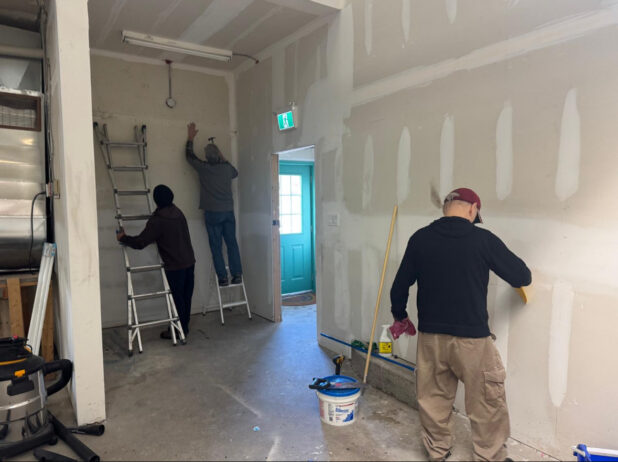
Renovations at the future Canadian Peace Museum in Bancroft are steadily taking shape, and with every day that passes, community support—and the museum’s purpose—grow stronger. According to the museum’s president, Chris Houston, the work now underway marks a turning point in transforming the donated building into a public space dedicated to fostering peace, environmental stewardship, and creating a more resilient community.
“We’re currently renovating the largest of rooms,” Houston said. “It’s lovely that people are just coming and helping out. It’s starting to feel like a real community space.”
The Canadian Peace Museum began gaining momentumafter the North Hastings Community Trust donated a building to the organization. Since then, locals have been stopping in, curious about the project taking shape in their midst. Houston is always ready to give a tour.
“It’s a process,” he explained. “People come around who are curious and ask questions about what we’re all about. It takes a while to get the word out.”
With renovation funds limited, Houston said the team is proceeding carefully. Despite the financial constraints, the museum remains on track for a partial opening in 2026. He said one of the major structural hurdles still ahead is accessibility.
“We’ve got some money to renovate,” Houston said. “Not enough to do it all, so we’re very frugally and slowly renovating. We’re delighted with the volunteers helping, and hoping that local businesses might help us out with lumber or materials to help us through the renovations… We need to have an elevator before we can open the top floor. We can’t have a museum promoting equal, fair and inclusive and not have an elevator.”
Design work is underway, and with the support of volunteers, donors, and local tradespeople. Houston offered special thanks to Maynooth artist and landscape designer Dave Maris, who has been instrumental in helping to move the museum closer to its goal of opening next year.
The world Houston envisions the museum nurturing is one grounded in justice, sustainability, and non-violence. Acknowledging how such a world feels increasingly distant amid rising global tensions, conflicts, and political polarization, he says, makes the need for the Canadian Peace Museum more urgent than ever.
“Every single time I speak to somebody, it sadly seems more relevant to promote peace,” Houston said. “Peace means many different things. It includes the absence of war, the absence of violence, and the absence of fear. But it also includes the presence of healthy people and a healthy planet. Peace is not just the absence of things—it’s the presence of things.”
Houston cited an article published in The Guardian, noting that more than five per cent of global emissions are linked to conflict or militaries. The United Nations has echoed similar concerns, warning in a 2023 report that warfare devastates ecosystems, contaminates water sources, and disrupts livelihoods.
“If you’re an environmentalist you’re a pacifist,” Houston said, emphasizing the connection between planetary wellbeing and peace. “War is very expensive. The carbon cost of war is ridiculous, and the legacy of war is forever.”
Recognizing that economic arguments also support a stronger global shift toward peace, Houston pointed out how war and violence are counterproductive in terms of building a stable global economy. When humanity focuses on killing and taking power from others for profit, he says the things that are in the public’s best interest—robust public health-care and education, food security, access to clean water and a safe environment—are neglected.
“The cost of violence is more than 10 per cent of the global economy; it’s larger than the economy of China,” Houston noted. “If you’re an economist, if you just care about money, then you should care about peace. If you care about people, you care about the environment.”
Houston believes Bancroft is the perfect place for this institution; not just philosophically, but practically.
“I think it’s quite wonderful that our beautiful, tranquil town—famous for its peacefulness in the sense of tranquillity—is a very fitting home,” he said.
The museum, once operational, is expected to diversify Bancroft’s tourism offerings and support the local economy.
“Bancroft is known for its outdoor beauty,” Houston said. “But that means when it rains or when it’s cold, people are looking for alternative things to do. Having an indoor space like this is important. It will put Bancroft on the map for a different set of people.”
One of Houston’s concerns is society’s weakening ability to hold respectful conversations across disagreement. This is an issue he sees most acutely in younger generations.
“People are struggling to have conversations where they disagree,” he said. “I fear for the younger generation. They seem to have an inability to have a conversation where they disagree… that’s not set up for a good society.”
To address this, the museum is already in discussion with the school board to ensure that students will have access to programming and exhibits that encourage critical thinking, conflict resolution, and meaningful dialogue.
For Houston, the most heartening part of the journey so far has been the spirit of collaboration emerging around the project.
“It really feels good to see the community getting behind us and stepping up in different ways,” he said. “It’s not just money or volunteering. There’s wisdom and advice, suggestions on what can be included in the museum.”
As renovations continue, and as global challenges make the museum’s mission increasingly relevant, Houston remains committed to advancing the Peace Museum’s mission to make Bancroft the Peace Capital of Canada.




Headline News

Daughter reflects on father, Arne Roosman’s legacy of kindness and creativity
By Nate Smelle At 5:10 a.m. on Jan. 15, the world grew less colourful with the passing of beloved artist, storyteller, mentor, and community icon, ...

Home Again fundraisers help animals in need
By Nate Smelle Since it’s inception in 2009, Home Again Animal Rescue has relied on the generosity of the community generosity, and the determination of ...

Municipalities don’t expect to run short of salt
By Bill Kilpatrick The last major road salt shortage occurred in 2018/19 and was the result of a strike by 350 Unifor Local 16-O members ...

NHHS wrestling team preparing for Bay of Quinte
By Bill Kilpatrick According to the North Hastings High School wrestling coach, Barb Gillis, the 2025-2026 wrestling team has “taken off with lots of pins ...

Huskies get two big wins in home opener
By Bill Kilpatrick On Thursday, Jan. 8 the junior and senior girl’s volleyball teams got the honour of being the first teams to play in ...
Limerick discuss Milfoil issue at Dec. 15 meeting
By Mike Riley Limerick Township council discussed an informal meeting they had virtually on Nov. 26 to discuss a growing Milfoil problem on their lakes ...
Bancroft’s mayor looks back on 2025 and forward to the year ahead
By Nate Smelle With the new year now underway, the Town of Bancroft is reflecting on a busy and transformative 2025, marked by major investments, ...

Exploring nature, space, and connectedness through landscape
By Bill Kilpatrick On Jan. 2 the Art Gallery of Bancroft held an opening reception for their first feature artist of 2026 Alex Jack, entitled ...
Peace Museum receives $10,000 donation
By Bill Kilpatrick Christmas came early for the Canadian Peace Museum this year when they announced on Dec. 23 that they had received a donation ...
Quarry proposed in Faraday Township
By Michael Riley Local Journalism Initiative Reporter A public meeting and a virtual public information session were held on Dec. 17 regarding a proposal for ...


